Image Block: Card Format
The image blocks on this page are set to use the “Image Card” format as in the first screenshot and the image can appear on the left or right. The advantage of using this format is that the text always stays with the accompanying image and at smaller viewports like on tablets and phones, as with the rest of the site, the image block card will “collapse” down to one column, but will still keep image and text in the same row and visually they’ll stay obviously connected.
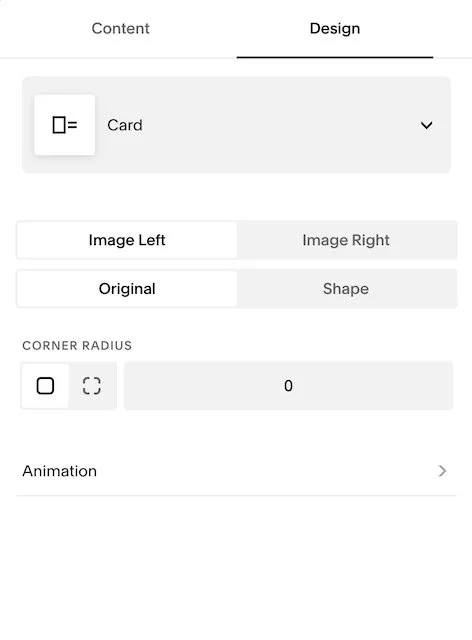
Screenshot of image block “Card” design.
Subtitle area: font size same as Image title area above.
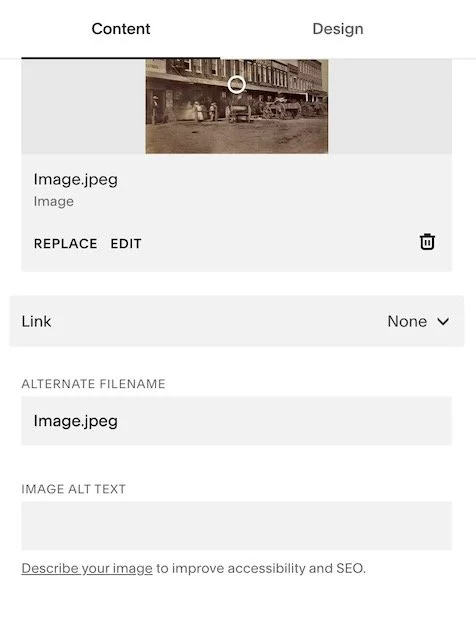
Both the image name and ALT tag can be set when adding images in the image block as in this second screenshot.
Most crucially for SEO and Accessibility, all images should be named something semantically meaningful and never generic, like “image.jpg”. Additionally it’s important to give each image an ALT tag, meaning a brief description of the content of the image itself. Like: Sepia toned photo of Dowe’s Photograph Rooms with carriages in the foreground.
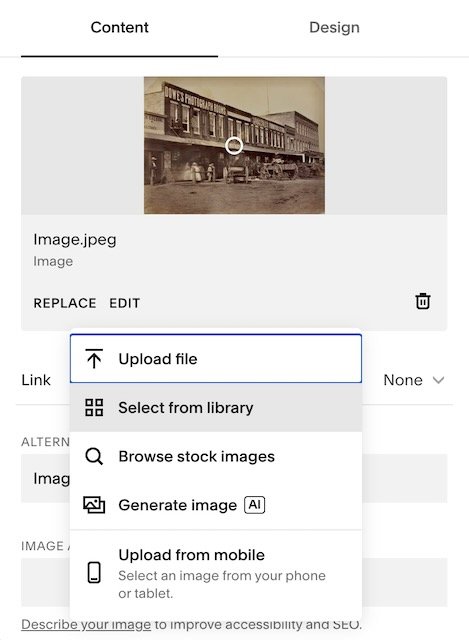
Also, I noticed that there are a lot of repeated image uploads in the Media Library, so just a reminder that once an image is uploaded, it’s then available to be reused in the Media Assets/Library.
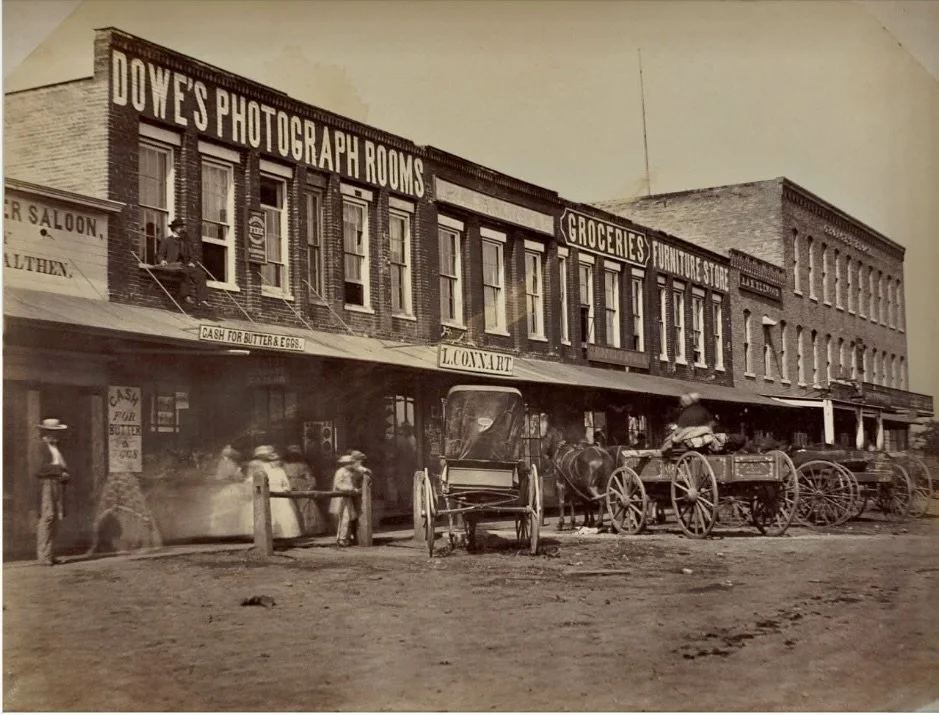
LEWIS DOWE’S PHOTOGRAPHIC STUDIO, SYCAMORE, ILLINOIS, C. 1862-1875
LEWIS DOWE was born in 1837 in Hanover, Grafton County, New Hampshire, and died in 1919 in Portland, Oregon.
During the Civil War, Dowe, an accomplished musician, served as bandmaster in the Fifty-Second Illinois Volunteer Infantry. After the war, he established a photographic studio in Sycamore, Illinois. He remained in Sycamore from around 1862 until 1875. In February 1871, the city’s True Republican reported that Dowe had created a collection of stereoscopic views of Sycamore’s public and private buildings, and in June, 1871 it reported that he had created stereoscopic views of the White Mountains in his native New Hampshire.

PETALUMA WEEKLY ARGUS, SEPT. 17, 1875, P.2.
Dowe departed Sycamore, Illinois, and in 1875 arrived in Petaluma. In September 1875, he set up his photography studio in the rooms formerly occupied by photographer Hugh Anderson (b. 1826; d.1900; active in Petaluma Jan. 1872 - Dec. 1873) located at 649 Main Street. Dowe lived with his wife on D Street, and they were socially active in Petaluma throughout their seven-year residency. Dowe was the leader of the Petaluma Brass Band and Petaluma’s Coronet Band, and his wife taught piano lessons. In October 1879, the Petaluma Weekly Argus noted that the Dowes had installed a telephone line between their home and photography studio.
Inline Image and Text block layout
Inline image blocks and text can be aligned as below using spacer blocks in this formation, but the issue with this method is that it takes more work due to having to use spacer blocks to achieved the layout and at device widths below desktop/laptop computers the alignment won’t collapse into columns keeping the text and image visually together quite as cleanly as using image cards. You can see this by “squishing” the width of your browser window.
LEWIS DOWE was born in 1837 in Hanover, Grafton County, New Hampshire, and died in 1919 in Portland, Oregon.
During the Civil War, Dowe, an accomplished musician, served as bandmaster in the Fifty-Second Illinois Volunteer Infantry. After the war, he established a photographic studio in Sycamore, Illinois. He remained in Sycamore from around 1862 until 1875. In February 1871, the city’s True Republican reported that Dowe had created a collection of stereoscopic views of Sycamore’s public and private buildings, and in June, 1871 it reported that he had created stereoscopic views of the White Mountains in his native New Hampshire.
LEWIS DOWE’S PHOTOGRAPHIC STUDIO, SYCAMORE, ILLINOIS, C. 1862-1875